

2026: the year AI transforms digital ecosystems — redefining identity, optimisation, and data infrastructure from the inside out.
The AI revolution can be characterized by applications: workflows can be done faster and with greater intelligence, creative tools can be smarter, predictive dashboards, and conversational interfaces. However, behind those superficial discoveries, there is a more fundamental change that is being implemented. Within 24 months, AI will not merely improve the digital ecosystems; it will re-architect the systems of identity, data collaboration, optimisation, and intelligence, the core systems.
This isn’t a tale of gradual efficiency—it’s a fundamental shift. Privacy-sensitive computation, unified identities, and agentic AI will redefine decades-old adtech and martech architecture. In this landscape, four leaders outline what the future should be, but it is not based on cosmetic innovation, but structural reinvention.
Table of Contents:
Interoperability Becomes an Infrastructure Layer — Not a Feature
Match Rate Becomes the New KPI of an AI-Driven Identity Layer
Agentic AI Will Rebuild, Not Retrofit, Digital Ecosystems
Creative Optimisation Becomes AI-Orchestrated, Not Human-Configured
The Re-Engineered Future of AI Infrastructure
Interoperability Becomes an Infrastructure Layer — Not a Feature
The existence of collaboration of data has had a fundamental paradox: organisations are interested in maximising the utility of data, their own and others’, and at the same time minimising the flow of sensitive data. Conventional resolutions have imposed trade-offs. The next era will not.
Alistair Bastian, CTO, InfoSum.
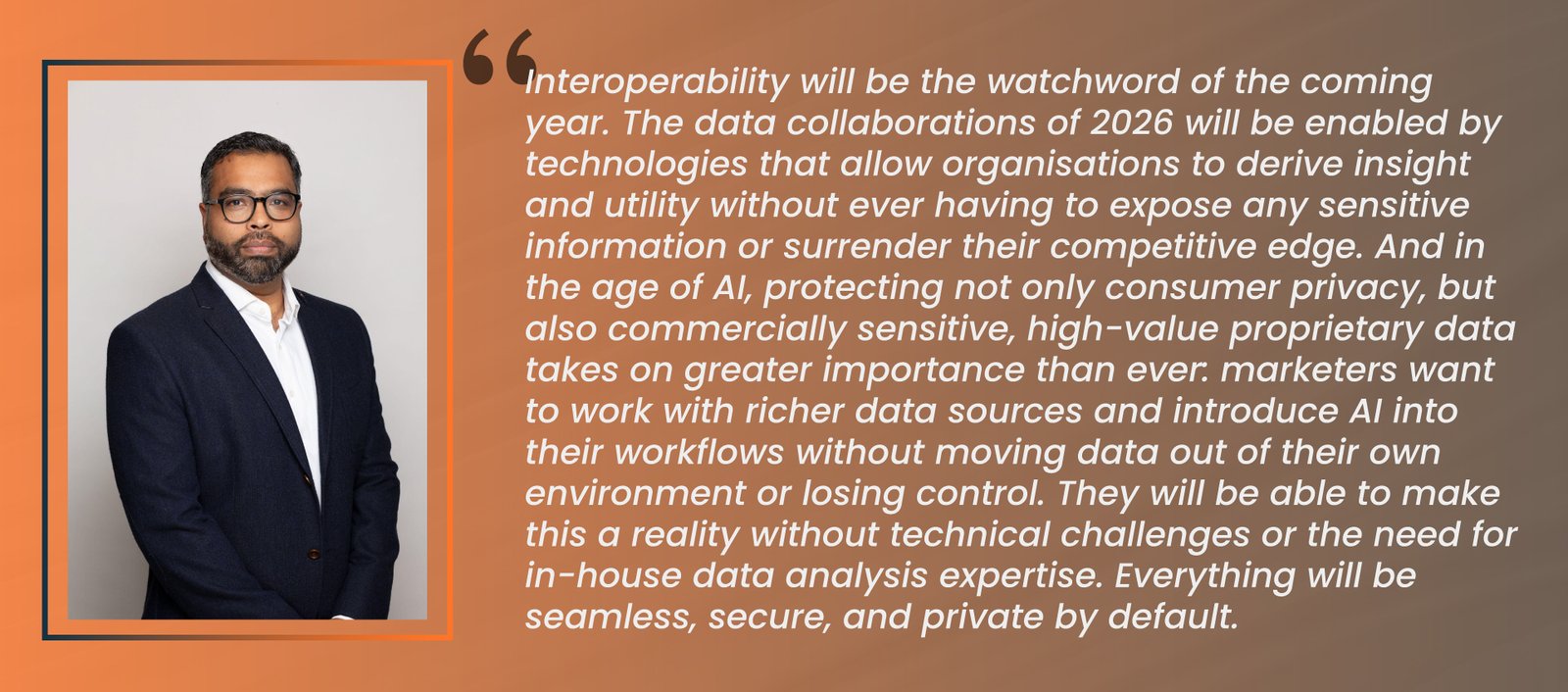
It is the emergence of zero-movement data intelligence, the AI engines, and privacy-protective computation, which transports insights to models, instead of data to third parties. Clean rooms transform into complete-fledged computation fabrics. Interoperability is no longer a governance issue but an AI-compatible architecture layer.
The implication is dramatic: organisations will be in a position to train and deploy AI models with distributed datasets they do not have access to directly. The ability to collaborate without being exposed will allow the company to gain a competitive advantage, not access to data itself.
Match Rate Becomes the New KPI of an AI-Driven Identity Layer
When the next generation of AI-first infrastructure is characterized by related knowledge, the next source of conflict is in the way the connection is achieved. Fragmentation of identity between devices, channels, and compliance frameworks is one of the largest bottlenecks in the industry–and AI simply increases the demand for standardised, high-fidelity identity graphs.
Mathieu Roche, Co-founder and CEO, ID5 captures this shift precisely:
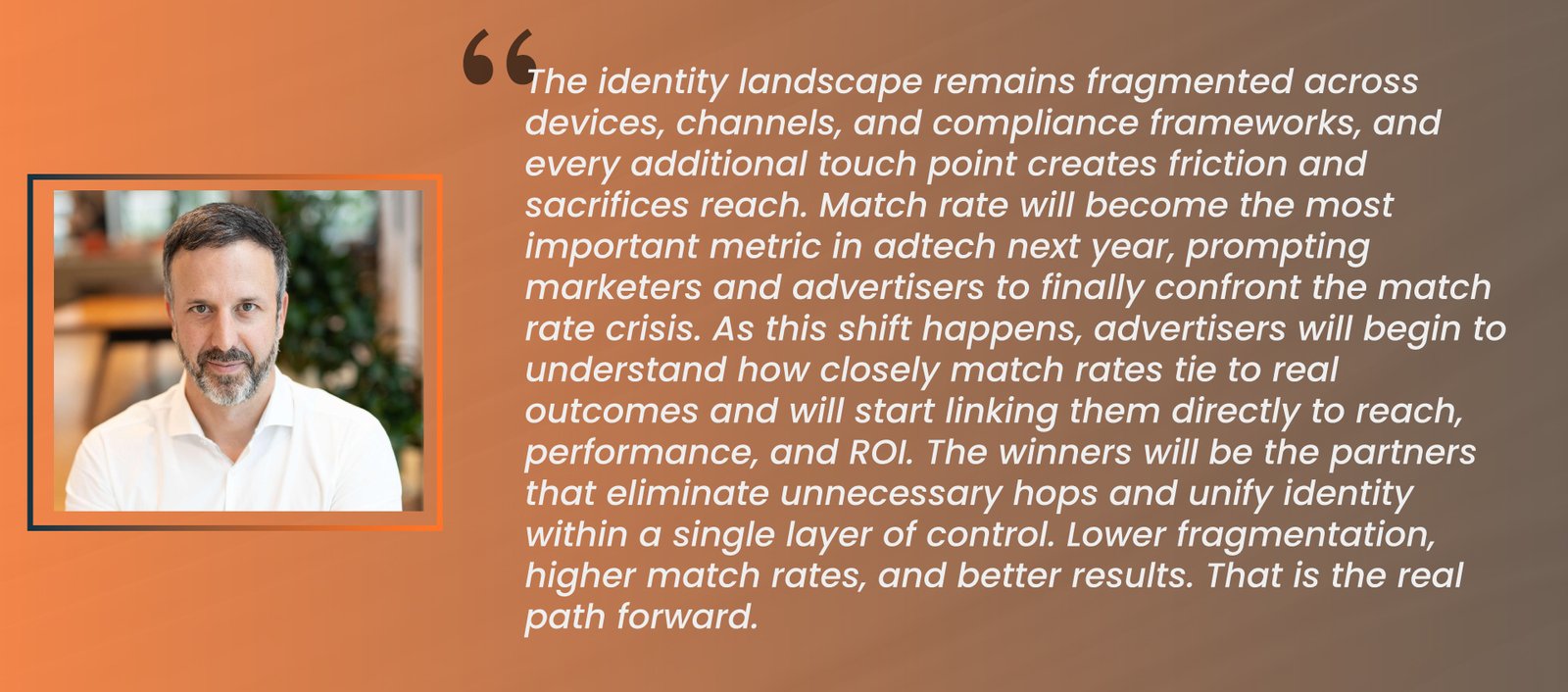
Match rate is not a measurement problem anymore in the context of AI; it is a model performance problem.
A fragmented identity layer gives rise to:
- incomplete training data
- imprecise viewer profiling.
- poor optimisation cycles
- desynchronized reinforcement learning signals.
One identity forms the required infrastructure for AI accuracy.
The story is changing: identity ceases to be a compliance headache or a targeting utility; it is the foundation upon which AI systems can reason about people, devices, and context in a reliable way.
Agentic AI Will Rebuild, Not Retrofit, Digital Ecosystems
Adtech and martech have been defined by patching in the past 10 years: layers of integration, point solutions that add onto older stacks. AI, and in particular agentic AI, removes this cycle.
Ian Maxwell, CEO, Converge, articulates a turning point many in the industry have sensed but not yet defined:
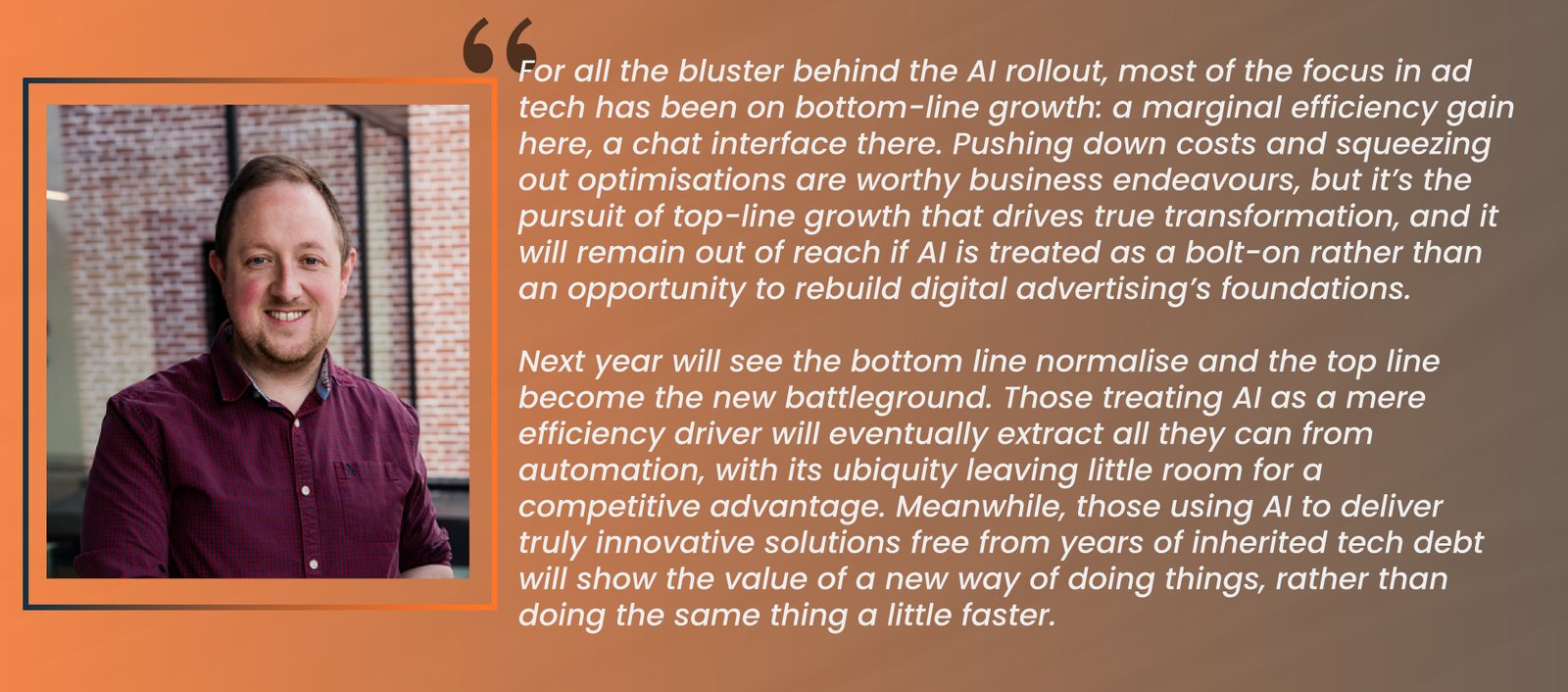
It is a roadmap of the transition toward AI-native systems instead of AI-assisted ones:
- AI on the legacy infrastructure will hit diminishing returns.
- Artificial intelligence, created as the heart of the new infrastructure framework, will produce non-linear benefits.
- The agentic AI will be used to make dynamic decisions in the areas of planning, buying, optimisation, and measuring.
The victors will not be the ones who automate the old workflows but enable AI to redefine the workflows altogether.
Creative Optimisation Becomes AI-Orchestrated, Not Human-Configured
As budgets get thinner, the creative layer, which has long been viewed as unnecessary, too human, too qualitative, too variable, emerges as an AI optimisation frontier. However, the next generation of AI-based creative tools is not restricted to early AI creative tools since creative generation is combined with both media strategy and predictive modelling in one continuous system.
Ivan Doruda, CEO, MGID, describes this shift:
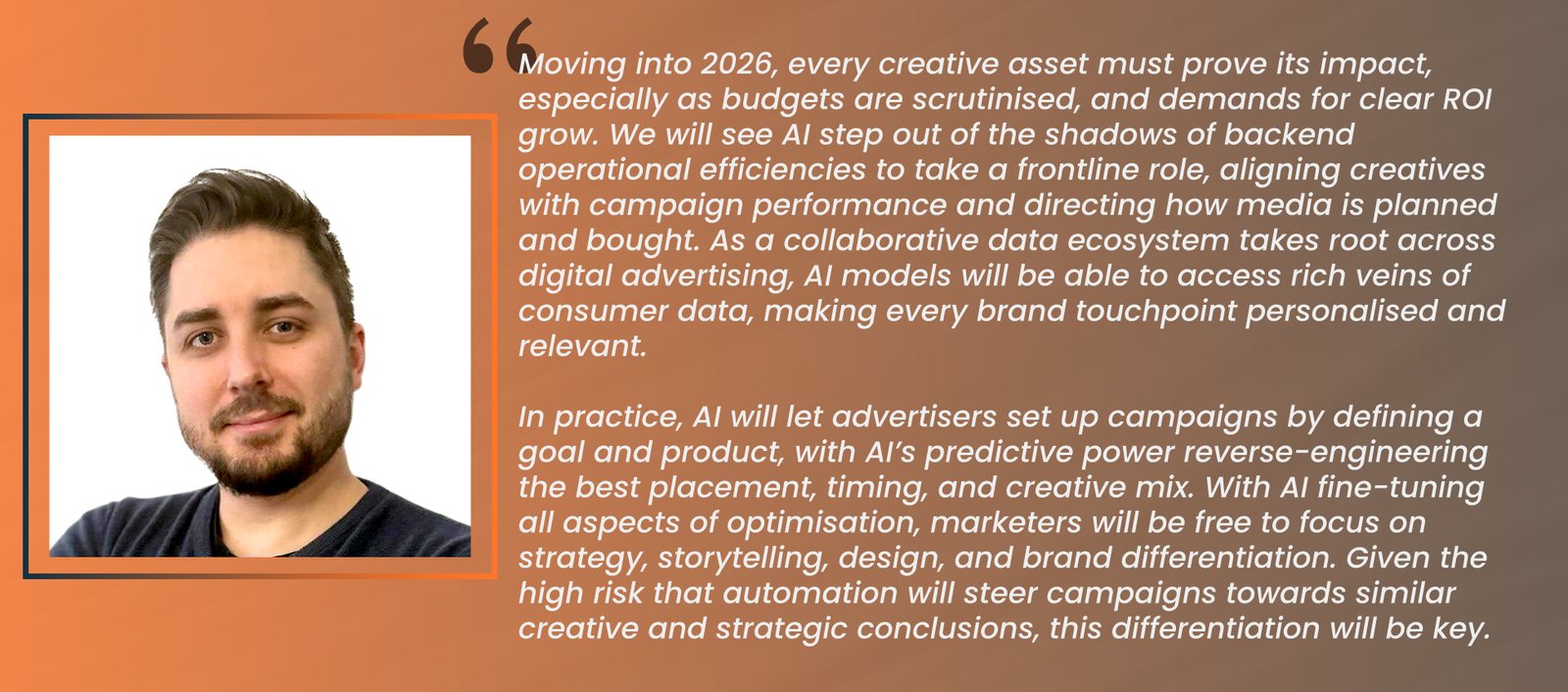
It is the rise of goal-oriented orchestration – AI systems that:
- generate creative
- represent the responsiveness of the audience
- establish the best sequencing
- allocate budgets
- and are self-correcting by real-time feedback
all out of one input: the aim of the advertiser.
What is also critical is the warning given by Doruda: with the convergence of optimisation, there is little differentiation. Patterns may be standardised by AI, but creativity is the variable that disturbs the homogeneity.
The Re-Engineered Future of AI Infrastructure
In these visions, there is a consistent story:
1. Data will be kept dispersed. Insight will not.
AI will be used on privacy-sensitive, non-moving data.
2. Identity will unify. Disintegration will crumble.
Instead of an operational metric, matching is a performance variable of AI.
3. There will be a reconstruction of the infrastructure. Not retrofitted.
End-to-end system repackaging Agentic AI will avoid years of technical debt.
4. Creative and media will fuse.
AI-driven optimisation will be used, and creativity will be left as the human differentiator.
It is less of the applications and more of architecture: the digital ecosystem of 2026 will be constructed on the grounds of architecture rather than one designed to accommodate AI as the native decision-making entity.
This is the year AI ceases to be a feature and becomes the basis.
Explore AITechPark for the latest advancements in AI, IOT, Cybersecurity, AITech News, and insightful updates from industry experts!