
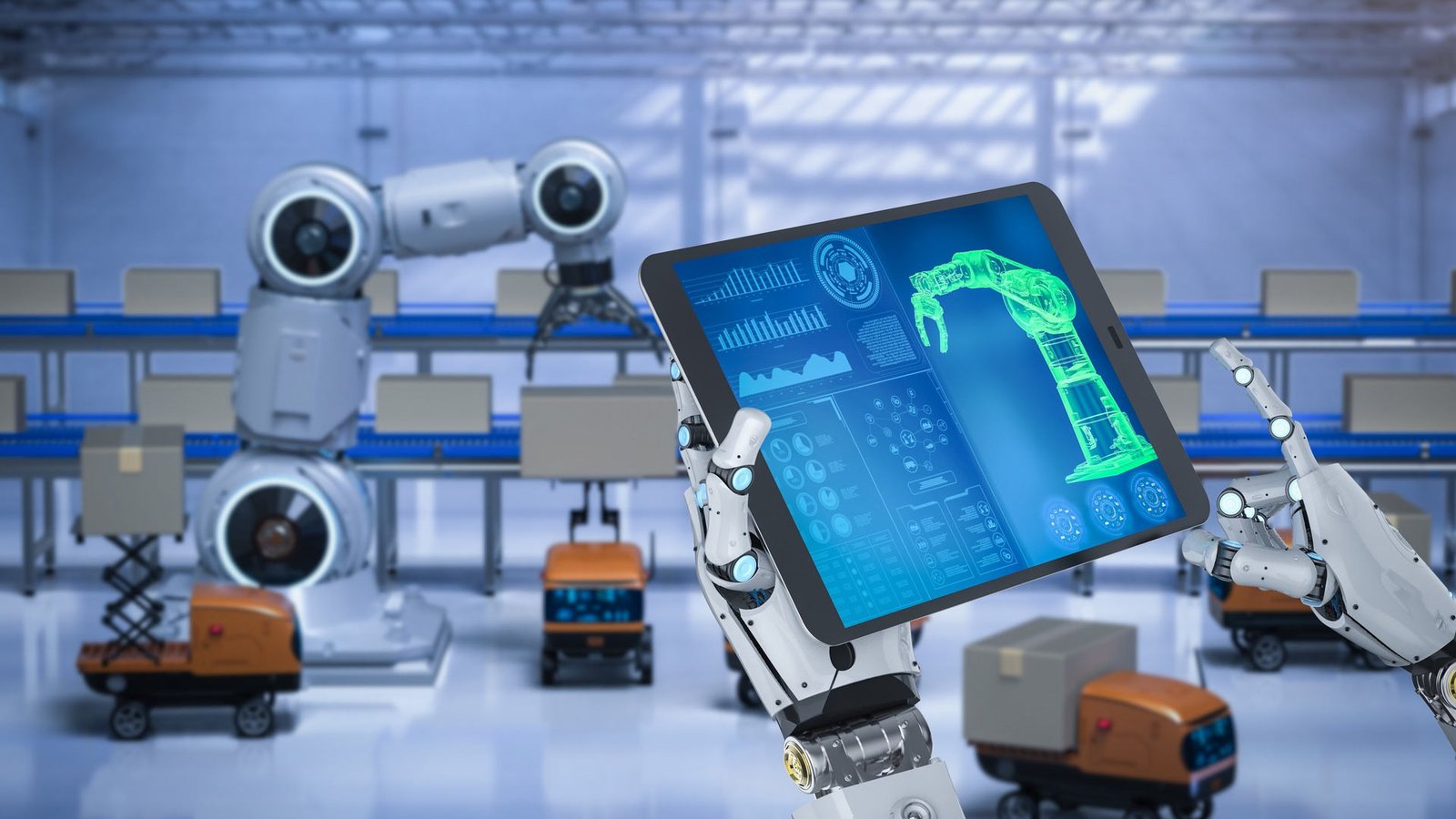
Explore how Edge AI in robotics is transforming smart manufacturing with real-time decision making, reduced latency, and enhanced operational efficiency.
Edge artificial intelligence (Edge AI) is rapidly transforming the face of industrial robotics, and a machine can now perform complex jobs autonomously and with very little latency. The local processing of data on or near robotic infrastructures, instead of relying on one centralized cloud, opens up real-time responsiveness, improved operational performance, and quality assurance of smart factories through Edge AI.
Robots with Edge AI will be able to adjust to the changing environment on the factory floor, aiding predictive maintenance, decreasing unplanned downtimes, and increasing throughput. These advancements form the core of smart manufacturing efforts across the globe, whereby real-time intelligence and automation are used to make production environments competitive and sustainable.
Table of Contents:
1. The Role of Edge AI in Modern Robotics
1.1 Real‑Time Decision Making and Latency Reduction
1.2 Predictive Maintenance and Operational Efficiency
1.3 Quality Control and Adaptive Automation
2. Edge AI Applications Across Smart Factories
2.1 Collaborative Robots (Cobots) and Hybrid Automation
2.2 Robot Fleet Coordination and Intra‑Factory Logistics
3. Market Trends, Deployment Challenges, and Future Outlook
3.1 Global Market Growth and Industry Projections
3.2 Integration Issues and Workforce Effects
3.3 Future Projections and Innovation Projections.
Conclusion
1. The Role of Edge AI in Modern Robotics
1.1 Real‑Time Decision Making and Latency Reduction
Real-time decision making is an important feature of smart manufacturing, as even one millisecond delay can cause a change in the production quality or safety. Here comes Edge AI, which enables industrial robots to process sensor data, like force feedback, vibration, and vision data, at the capture point. These systems can reduce latency by a huge margin because they do not have to transmit raw data to remote cloud computers to be processed and inferred.
This allows robots to react immediately to the change in environment and turbulence in the environment, and be accurate in controlling complicated activities, without the help of a network. Industry analyses claim that implementations of Edge AI have the potential to reduce processing latency by tens of milliseconds relative to cloud-only deployment, resulting in more dependable, time-constrained control loops in automation and assembly processes.
Localized inference lowers bandwidth consumption and operational risk, besides enhancing responsiveness. Since only the necessary insights are passed on instead of the raw sensor information, the factories do not have to spend a lot of money on the transmission of data, but can still provide high throughput. This is particularly useful in vision-based inspection and synchronized activity of robots along production lines, where high-resolution data streams would otherwise overwhelm networks.
1.2 Predictive Maintenance and Operational Efficiency
Predictive maintenance is one of the most influential applications of Edge AI in manufacturing robotics, as Edge AI systems detect anomalous behaviors by constantly checking the health of the machines in operation by local analytics of vibration, acoustic, and temperature data, prior to turning into failures.
Besides reducing expensive production breakages, predictive maintenance increases the life of the assets and improves maintenance planning. Instead of maintaining machinery at a defined frequency, factories have the opportunity to use the real-life condition data to plan the maintenance process during the planned downtimes.
McKinsey reports that companies implementing Edge AI in predictive maintenance programs record time downtimes of 25-30% and maintenance savings that can make a big difference to the total cost of ownership.
In addition to maintenance, Edge AI enhances energy usability and efficiency of processes. Having machines adjust their settings in real time, using data about the operational processes and machine learning-provided insights, can help factories minimise waste and save energy.
1.3 Quality Control and Adaptive Automation
Automated quality control is another domain where Edge AI delivers measurable gains. High-speed vision systems with edge processors are capable of performing detailed inspections at the production line itself and identifying defects too subtle or moving too fast to be detected by other systems. This has allowed real-time detection of errors so that defective items do not advance along the line and scrap and rework are minimized.
Adaptive automation continues this concept by allowing robots to change their behavior on the fly in response to AI feedback. An example is that robots can recalibrate force or path when working on assemblies of variable components, and cycle times can be minimized, and accuracy can be enhanced. Such systems are useful in other types of industry, like electronics and car manufacturing, where even small variations can affect the performance of the product.
2. Edge AI Applications Across Smart Factories
2.1 Collaborative Robots (Cobots) and Hybrid Automation
Collaborative robots, or cobots, are programmed to work in a safe environment with humans and play a crucial role in hybrid automation. Edge AI enhances these systems with the ability to provide the cobots with real-time situational awareness and decision-making abilities on the factory floor. Cobots are capable of changing reaction to human presence, changes in part orientation, or unexpected obstacles without stopping work because it has low latency and local intelligence to interpret sensor data in real time and adapt.
The integration of Edge AI makes it easier to implement more adaptable automation plans, as humans and robots can distribute the tasks according to the situational-specific information. Cobots equipped with on-device AI can switch tasks between feeding parts, fastening and inspection in automotive and electronics assembly lines with minimum programming requirements, which can be useful with high-mix and low-volume production.
2.2 Robot Fleet Coordination and Intra‑Factory Logistics
Edge AI is not limited to a single robot and is used to manage large groups of autonomous guided vehicles (AGVs) and robots in production and logistics centers. The local edge agents maintain movements and dynamically re-plan routes of production units depending on the current floor conditions and production needs. This method eliminates handling mistakes and enhances throughput, especially in plants that have peak demand intervals resulting in congestion. Proper edge-based coordination also contributes to material flow just-in-time and intra-factory logistics.
Edge AI systems are used in the warehouse setting to monitor stock levels and direct AMRs (autonomous mobile robots) to move around in a timely manner, moving materials to the assembly stations immediately. The ability abates the bottlenecks and enhances coordination between the production and supply chain processes, which is a part of the lean manufacturing principles.
3. Market Trends, Deployment Challenges, and Future Outlook
3.1 Global Market Growth and Industry Projections
The global Edge AI market in robotics is set to experience a surge in smart manufacturing initiatives expanding across sectors. According to market research, the edge-enabled robotics solution in the market is experiencing an upward trend in its rate of adoption, owing to the need to attain real-time analytics, autonomous operation, and low cost of operation.
Despite certain projections being inconsistent, there is an ongoing indication of massive increases in deployments in the industrial field of automation, logistics, and smart factory applications. This tendency is the search for manufacturers for resilience and efficacy in the ever-growing, complicated production settings.
The developments in specialised edge processors, neural processing units (NPUs) and lightweight machine learning frameworks also enable growth and ensure that high-performance AI can be executed on edge devices. These hardware/software advances reduce the implementation costs and increase the applications of robotics, which can utilize edge-based intelligence.
3.2 Integration Issues and Workforce Effects
Regardless of its potential, there are technical and organisational challenges to integrating Edge AI into the current manufacturing robotics ecosystems. Most of the facilities have to upgrade their old equipment and retrofit their sensors and networking infrastructure to support edge deployments. Interoperability between heterogeneous systems, such as robots, programmable logic controllers (PLCs), and human-machine interfaces, demands that considerable attention be paid to design and testing.
Cybersecurity is another important consideration, since the intelligence can be found on edge nodes, the manufacturers need to have strong security controls, such as encryption of data, authentication of devices, and so on, in order to reduce the risks related to the decentralized processing.
It is also having a tremendous effect on the workforce. Although Edge AI and robotics could minimize repetitive or dangerous jobs, it would require new abilities in AI supervision, robot programming, and edge platform management. To enable workers to move into positions that enable edge-based automation, maintenance and analytics, upskilling and reskilling should be implemented.
3.3 Future Projections and Innovation Projections.
In the future, even more smart manufacturing will be achieved through innovations at the edge of Edge AI, robotics, and next-generation connectivity, such as 5G and beyond. Long term trends are in distributed edge networks, which facilitate collaborative intelligence among fleets of robots, simulation-driven optimisation through the integration of digital twins, as well as real-time decision support systems.
Also, the hybrid edge-cloud architecture will provide a balance between local responsiveness and global analytics through which factories will be able to utilize immediate insights and strategic processing in the cloud. Such developments will open up the possibilities of autonomous operations and adaptive production plans and make Edge AI one of the enabling factors of future industrial automation.
Conclusion
The development of industrial robotics and smart manufacturing relies more on Edge AI. The edge-driven systems are more efficient and minimize downtime, optimize the production accuracy and allow real-time decision making, predictive maintenance and adaptive quality control.
With increased hardware capabilities and integration challenges being solved, further innovations that will transform how automation and operational excellence are achieved will require Edge AI. It is a fundamental part of the future industrial environment because it is essential in the development of resilient and intelligent factories.
Explore AITechPark for the latest Artificial Intelligence News advancements in AI, IOT, Cybersecurity, AITech News, and insightful updates from industry experts!