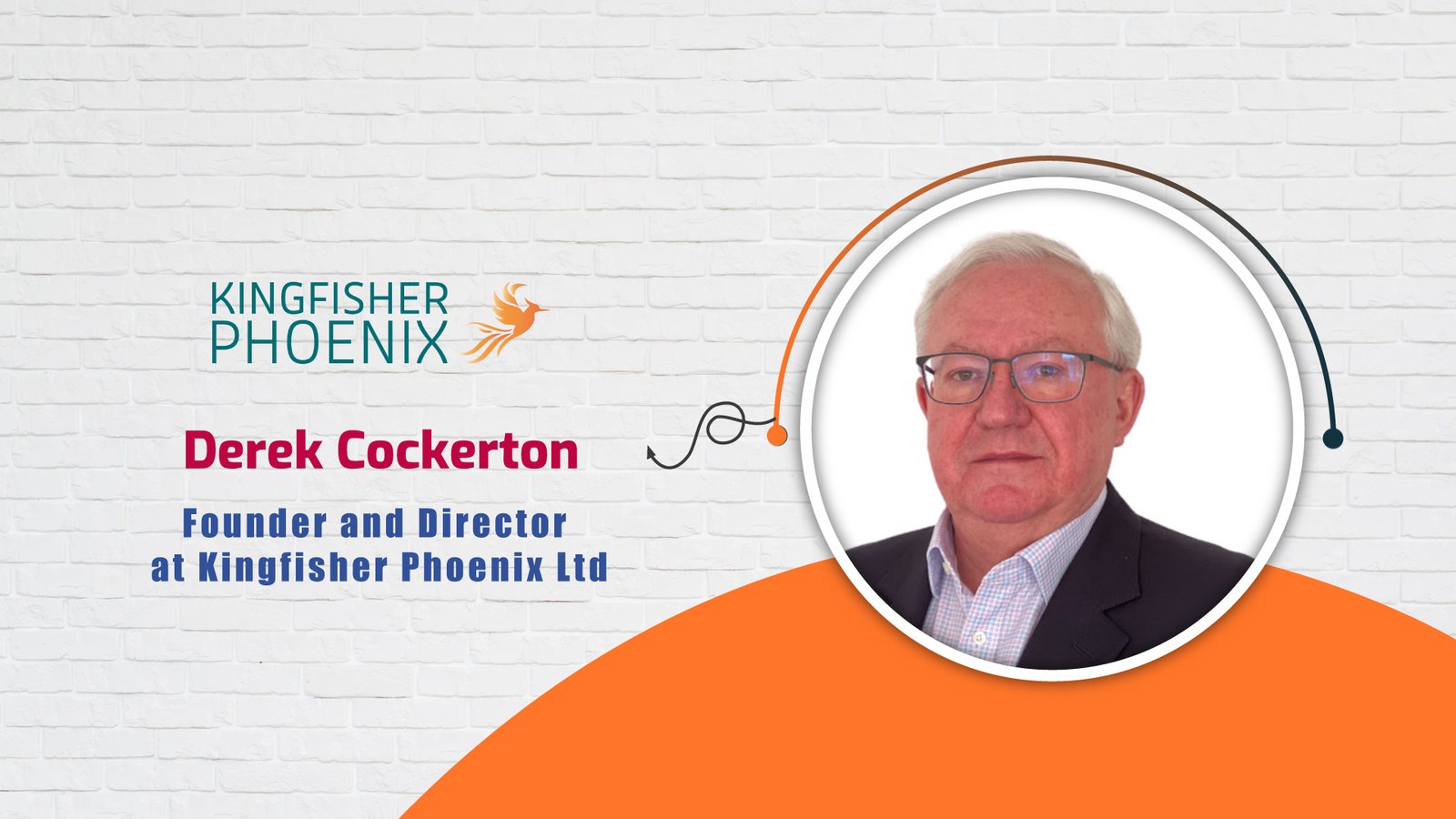
Insightful interview with Derek Cockerton on how Kingfisher Phoenix Ltd uses ethical AI to reduce loneliness and drive meaningful social impact.
Welcome to the AITechPark, Derek. To start us off, could you share your professional journey and what inspired you to start Kingfisher Phoenix Ltd?
I founded Kingfisher Phoenix Ltd as a consequence of a lived experience very common amongst over 55’s; a powerful combination of having had my last role made redundant in mid-2022, whilst studiously searching for a new career. Since then, I’ve had a potentially life shortening health scare in Feb 2023 (thankfully a false alarm) and was doing whatever was necessary to keep the proverbial wolf from the door, all whilst coming to terms with the emotional outfall from these life events . Loneliness became a real persistent issue during this time. However, I was very lucky – I was supported by friends, family, community, and professionals; too many older people living alone are forced to exist in silence.
As someone with a strong tech background, what personal experiences or insights led you to focus on addressing loneliness and care as core business drivers?
Before I answer that, I believe it important to define what loneliness really is and what it is not. University of California Los Angeles (UCLA) research first published in the late 80s defines loneliness as ‘as the subjective, unpleasant experience that occurs when a person’s network of social relations is deficient in some important way, either quantitatively or qualitatively, meaning there is a significant mismatch between desired and actual social connections. This unpleasant feeling arises from a discrepancy between the level of social connectedness a person desires and the level they actually perceive in their relationships’. Counterintuitively one can be lonely even when in the company of others – the late Robin Williams expressed it very eloquently when he said ‘I used to think the worst thing in life is to end up all alone. It’s not. The worst thing in life is to end up with people who make you feel all alone’. Of course, solitude is very different from loneliness in that solitude is typically healing or restorative, whereas extended loneliness is both mentally and physically debilitating especially over extended periods of time.
In 2020 The Department of Culture, Media and Sport here in the UK published a paper revealing the cost of persistent to consistent loneliness amongst working age adults as measured on the UCLA simplified scale measured conservatively at £9700 per annum; that increases to almost £12 000 per person per annum (£15 000 adjusted for inflation).
Given the financial burden of persistent loneliness to the UK economy, never mind the toll on the health and shortened lifespan of those struggling, it became obvious to me deploying carefully curated technology specifically targeted at this increasing challenge and almost forgotten segment of the population, could radically improve the lives of the lonely amongst us and reconnect them safely back to more meaningful lives. Of course, we are under no illusions – technology cannot and will not replace human contact within my lifetime despite the hype and promise of AI today, but it can be effectively deployed to mitigate that loneliness and that has been demonstrably proven across thousands of users to date.
Loneliness is increasingly being recognized as a public health and ESG issue. How have you seen this shift in perception evolve, and why is it critical for businesses to take notice?
Aside from the DCMS study I referred to in my previous answer The US Surgeon General, Dr. Vivek Murthy, has declared loneliness an “epidemic” and a “profound public health challenge” with significant impacts on both individual and societal health. Loneliness is linked to a greater risk of premature death, comparable to the risks of smoking 15 cigarettes a day and is also associated with an increased risk of cardiovascular disease, dementia, stroke, depression, anxiety, and physical inactivity. He is not at all mistaken and the UK metrics are closely aligned with the US findings.
This is a societal challenge, not something we should leave for ‘others’ in the form of the Government, Social Services, Charities or the overburdened NHS to solve – they cannot with the resources they have in their current arsenal today. Every single business of every size owes it to themselves to pay attention beyond current mental health provisions and care they provide to employees today. This is not a question of adding to their already stretched cost burden but instead collectively providing them with more (cost) effective tools and methodologies they can deploy early on e.g. when they notice employees perhaps not at their best because those people may not be lonely themselves but may be trying to find effective solutions to mitigating the loneliness of a close family member; loneliness has no age limit albeit we are focusing on the over 60’s for now.
Many AI solutions prioritize speed and cost savings—but care requires a different approach. In your view, how can AI be designed with compassion and empathy at the core?
Curated, properly ethically trained AI has the potential to be a force for good in many sectors of the economy. In the areas of Health and Social care we need to be especially vigilant to ensure we don’t allow the current hype and enthusiasm around AI to overrun ethical considerations. I’m reminded of a question one of my managers asked me a long time ago when designing components for a complex piece of mechanical technology; “Are you sure this is necessary in its current form and are you sure it is not going to cause any harm in the future….consider the unofficial Law of Unintended Consequences?” A powerful question not asked frequently enough in so many areas of technology development.
What is the role of prevention in care, and how can purpose-led innovation help drive both social impact and long-term business sustainability?
I believe we can all agree prevention of any illness or negative social malady is far better for everyone than even the smallest amount of treatment and obviously way less expensive in terms of time and money. That said, I believe we also need to recognise in the areas of social care in the UK and indeed globally, that we will never have sufficient numbers of professional carers. With that in mind, the logical ‘next step’ questions then begin to form along the lines of what preventive measures can we as neighbours, families, communities, employers and indeed educators can take to reduce loneliness.
How are you currently using AI at KPL to solve real-world societal challenges, and what results have you seen so far?
We are currently focused on reducing loneliness amongst the over 60s and we are seeing very encouraging results within relatively short term time frames – over 80% of users report feeling less lonely when using our technology; over 90% report improvements in wellness amongst users with the same number stating an improvement in their overall quality of life (PGI-C scale) and perhaps the most encouraging of all over 50% of users reported our technology helped them reconnect with other people.
What are some practical steps C-Suite leaders can take to integrate AI into their business strategies in a way that supports community investment and social good
That’s a tough question to answer because everyone starts from a different position and perspective in my experience. If your business is not a specialist in social care, consider partnering with specialist organisations and charities that are – you will always be more effective together than you might be operating separately. Research, research, research is critically important – investing into to right community or platform with the right partners at the optimal moment is key. This is global challenge increasing in severity daily but every journey of note, and this is a worthy endeavour indeed, begins with the first step. Take the considered step.
From a personal strategy standpoint, how do you balance innovation, impact, and growth as a founder in a mission-driven company?
I believe our mission and my personal responsibility is to ‘pay it forward’ into our over 60’s here in the UK. Of course, we need to be financially viable to achieve our goals but more than that we need to remember daily we have been given a huge opportunity and indeed responsibility to improve the lives of over 4 Million older adults here in the UK by working with employers, Charities, the NHS, Social Services, Care Providers, Care homes and in time individuals who perhaps can’t wait to start chasing the black clouds of persistent loneliness back over the proverbial horizon.
What advice would you give to other founders who are building technology with a social purpose in mind?
I paraphrase Winston Churchill’s speech at Harrow in 1941 but it is ever true – “Never give in, never give in, never, never, never, never—in nothing, great or small, large or petty—never give in except to convictions of honour and good sense. Never yield to force: never yield to the apparently overwhelming complexities your solution might entail. Rember instead the good you will do and the lives you will improve of all those around you.”
Finally, any thoughts you’d like to share on the future of KPL and what excites you most about what’s ahead?
I’m excited about the future. For a very long time we have had an august group globally and within the UK comprising charities, academic, commercial and state funded organisations. They are all researching and doing their level best to defeat the challenge persistent loneliness represents individually and collectively to us all. However, they are unable to really do anything different to make really effective differences to the outcome of this growing problem. The team at Kingfisher Phoenix Ltd. and our partners believe we have the technology and capability to work with these erstwhile bodies and organisations to make that meaningful difference and that is so exciting – can you think of a more noble outcome than being able openly discuss loneliness without stigma and simultaneously improve the lives of over 4 million valuable older adults? I for one cannot…I hope you will join us on our mission.

Derek Cockerton
Founder and Director of Kingfisher Phoenix Ltd
Derek Cockerton is the founder and director of Kingfisher Phoenix Ltd, a company on a mission to harness the power of technology to improve the lives of individuals over 60’s by mitigating loneliness . An experienced technology executive with global exposure, Derek has held senior roles at IBM, HPE, Dell Technologies, and World Wide Technology Inc., where he led significant digital transformation and infrastructure projects across international markets.
With over 30 years in the tech industry, Derek combines extensive technical expertise with a passion for inclusive innovation. His work at Kingfisher Phoenix reflects a personal commitment to ensuring that technology creates real-world impact for aging populations.