Moving past surface-level experiments requires operational workflows. Cross-functional alignment remains the foundation for true enterprise maturity.
Trevor, as you step into the role of Chief Executive Officer at KNIME, how are your previous leadership experiences shaping your vision for the company’s next chapter?
Once a business has a clear sense of its strategy, its customers, and its offering, the role of CEO becomes a bit like designing a complex game. You’re creating systems and structures – everything from pricing to compensation schemes to physical offices to software tools – that other people will inhabit and interact with. If you tune those systems correctly, you have happy players and a successful business. If you get it wrong, you end up with either a business that isn’t growing or frustrated people – or, more likely, both.
While there are many examples of twenty-something founders who get lucky (I was one of them once), there is no substitute for experience in knowing where to focus and in what sequence to build the systems that drive success. I hope to bring both the benefit of great experiences and the lessons learned from mistakes to KNIME.
Organizations often view governance and explainability as slowing innovation. Why do you believe strong data foundations are now essential building blocks for true AI maturity rather than constraints?
We’re in a moment when a lot of attention is being paid to a particular type of project – AI-driven experimentation led by bold individuals within organizations aiming to drive automation. Those maverick efforts are exciting, but most of these “vibe coding” projects will never scale. That’s not really what they were meant to do.
Governance is one reason these projects fail, but it’s only one piece of what’s required to build applications that scale across the enterprise. Auditability, explainability, the ability for multiple people to collaborate on a project (i.e., to maintain it, debug it, and expand it), managing cost and performance dynamics, and ensuring proper data access control inside and outside the enterprise have always been hallmarks of technology that works at scale. These are not new to AI, but they are essential for mission-critical operations in large organizations.
Many enterprises invested early in AI with high expectations. Where did assumptions around speed, automation, and return on investment diverge from reality?
The first frontier of AI is personal productivity. People get excited when AI can save them an hour in their day by posting to LinkedIn, summarizing emails, or drafting a project brief. These are meaningful time-savers at the individual level. However, at enterprise scale, gains from individual contributors and managers tend to be uneven and take time to materialize.
The next frontier is enterprise productivity. That’s where KNIME is focused, and where I believe the real gains will come – by leveraging our footprint and framework to enable large-scale efficiency improvements, not just in day-to-day tasks, but in mission-critical business operations.
From your perspective, what distinguishes companies that are genuinely advancing in AI from those still experimenting at the surface level?
Companies approaching AI at a surface level tend to ask, “How can we replace low-level staff with agents?” They focus on use cases like customer service, data entry, and basic analysis.
More forward-thinking companies take a top-down approach. They look at entire areas of activity and ask how those could be better managed by teams of AI capabilities, while identifying where humans need to remain in the loop. They question whether existing operational structures (in HR, Sales, Marketing, and Design) should remain the same, or evolve in response to new AI capabilities being deployed in fundamentally different ways.
How should leadership teams align talent, data strategy, and technology investments to transition from isolated pilots to enterprise-wide AI impact?
Approaching AI from siloed perspectives (whether it’s HR focusing on talent, IT investing in technology, or data teams launching projects) is not ideal. The most effective approaches are use case-driven, allowing organizations to look holistically across disciplines and ask: how can AI improve efficiency and/or quality in a specific part of the business?
From there, cross-functional teams can collaborate and invest in software, data, talent, and organizational changes as needed.
There has been significant focus on developing ever more advanced models. Why is the conversation shifting toward operationalizing AI through governed, repeatable workflows?
It is telling that the biggest recent developments in AI haven’t been dramatic leaps in frontier models, but rather projects like OpenClaw, Claude Code, Cowork, and OpenAI Codex – tools that provide practical use cases and effective ways to harness AI. That’s because AI is already incredibly powerful, and the real challenge now is making it usable, reliable, and scalable in real-world environments.
What measurable indicators signal that AI is embedded into day-to-day operations rather than confined to innovation labs?
Much like you can tell that a company isn’t truly international if it has a “Head of International,” or that it isn’t truly innovative if it has a “Head of Innovation” (what does everyone else do?), a similar principle applies to AI. As long as AI is treated as specialized experimentation, and deployments are pursued for AI’s sake, it hasn’t yet become an operational priority.
As KNIME enters a new phase of growth, how will you scale integrated data and AI capabilities while maintaining transparency and trust across the organization?
KNIME atomizes and governs data and AI processes so they are transparent, repeatable, and understandable, and so they operate within defined guardrails. We use our own platform every day across every department to better understand and automate what we do.
Being heavy users of our own tool helps in every respect. It helps us evolve the product, and it gives us valuable perspective on how to help other organizations design and deploy their processes on KNIME. It’s much easier to explain how to use the platform in daily data work, and how to manage data-driven change, when we’ve faced those same challenges ourselves.
With your track record of expanding global SaaS businesses, what lessons about scaling culture and processes are most relevant to accelerating AI adoption responsibly?
Many organizations have a few “data heroes” – bold individuals who generate great ideas about how data and AI can drive insights or efficiencies. A CEO can ensure those ideas are not only recognized, but also supported by the full organization so they can scale to benefit the company as a whole.
At the same time, leaders must ensure that new ways of working align with the organization’s culture. It’s not enough to simply mandate change. Teams need to understand why change is necessary and how it will impact them.
I’m fortunate to lead a highly innovative and flexible team. But every culture tends to favor stability, while the job of the company is to keep evolving. Aligning what is best about the business today with a vision for tomorrow is both the most important and the most difficult responsibility of a CEO.
Looking ahead, how do you see the role of explainable, governed AI evolving as organizations move beyond experimentation and focus on long-term business value?
In the future, our relationship with AI at work will be more complex and nuanced. Sometimes AI will feel like an army of helpers; other times it will act as a colleague or collaborator; and at times, even as a kind of manager, guiding us toward the most effective actions. What it means to be “in the loop” as a human, and how we support AI while it supports us, will be fascinating to explore.
At the same time, many of the activities we consider “work” will fundamentally change. For example, much of daily life revolves around ratings and scores (star ratings, debt ratings, NPS, etc.) because they simplify complex information.
But instead of relying on averages, AI can analyze underlying data instantly and provide context-specific insights tailored to our needs in a given moment. That could offer a far more accurate assessment than a single generalized score.
Whether or not we move toward a post-rating world, it’s clear that fundamental aspects of life and business will change, not just how we produce work and insights, but what we choose to produce. It’s both a frightening and exciting time ahead!
Quote: “The leaders effectively navigating AI are those moving beyond siloed experiments and focusing on use case-driven, cross-functional efforts that can scale into real enterprise results.“

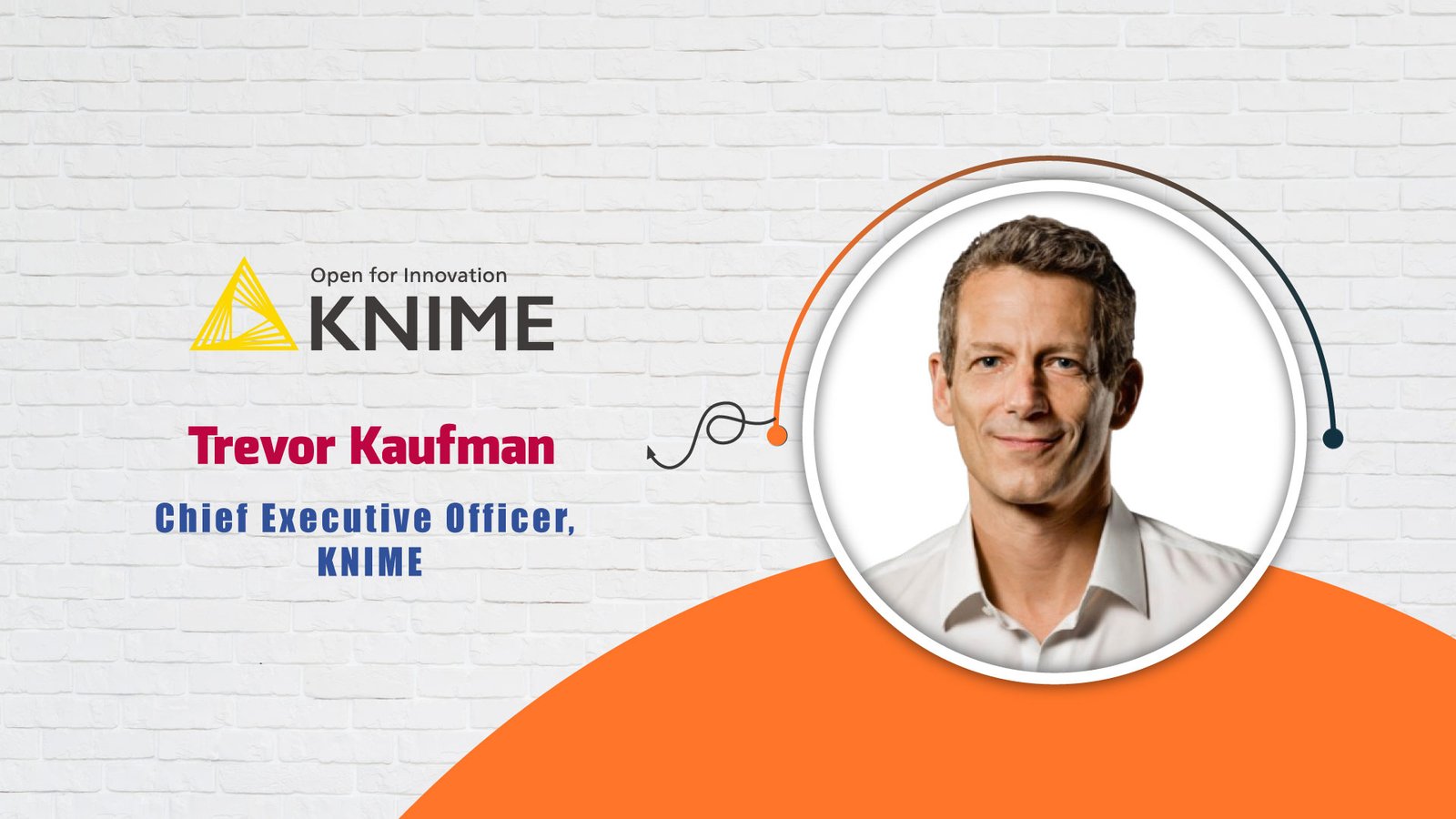
Trevor Kaufman
Chief Executive Officer, KNIME
Trevor is the CEO of KNIME, where he leads the company’s growth in AI-driven data science, analytics, and agentic action. A seasoned technology executive and entrepreneur, he previously served as CEO of Piano, a global personalization and subscription platform, and prior to that, was founder and CEO of Schematic, a digital innovation consultancy. Schematic was later acquired by WPP, where he ran a network of WPP’s digital acquisitions. Over the course of his career, Trevor has built and scaled global SaaS and digital businesses, serving countless global brands with a focus on innovation, culture, and sustainable growth.